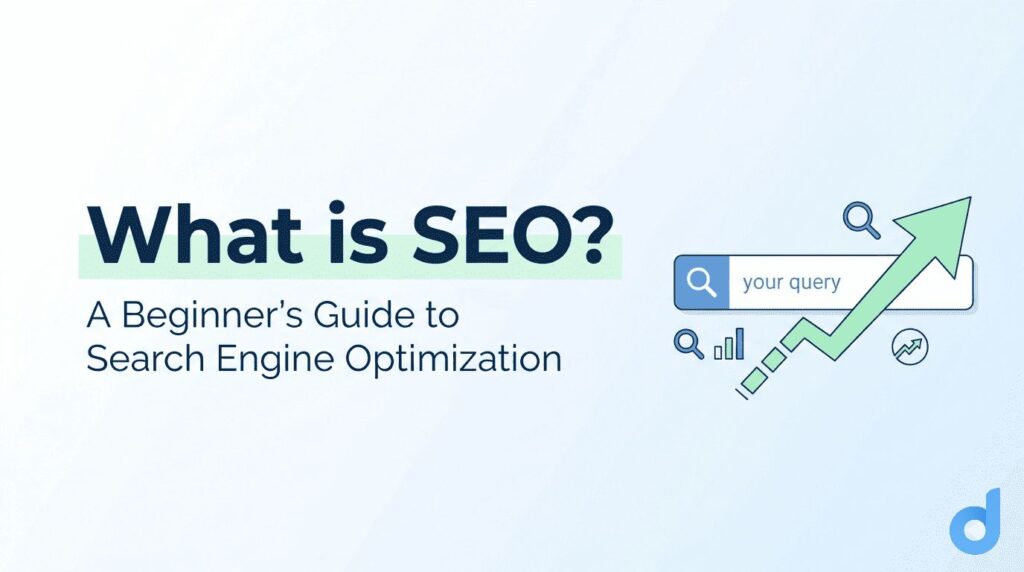
SEO stands for Search Engine Optimization.
In simple terms, SEO is the process of making your website easy for search engines like Google, Bing, and Yahoo to understand — so they can show your website to people who are searching for topics related to your content.
Think of it this way
Google has billions of web pages to choose from. SEO helps Google understand that your page is the best answer to someone’s question — so it shows your page first.
When done right, SEO brings free, targeted traffic to your website — people who are already looking for exactly what you offer. No ads. No daily budget. Just people finding you naturally.
Here’s the truth: 93% of online experiences begin with a search engine. If your website doesn’t appear on the first page of Google, most people will never find you.
SEO is important because it helps you:
27% of all Google clicks go to the #1 result.
By position #10, that drops to less than 3%. The same search — but 9× fewer visitors. That’s why ranking matters, and why SEO is worth learning
Let’s say you publish a blog on your site about “What is SEO?”
Someone searches on Google:“What is SEO for beginners”
Google shows the most helpful, well-optimized articles at the top.
Google doesn’t manually pick which website comes first. Instead, it uses automated programs called crawlers (also called bots or spiders) that constantly browse the internet. These crawlers follow links, read your content, and report everything back to Google.
Once Google reads your website, it goes through three powerful steps — and these steps run every second, for every search, worldwide:
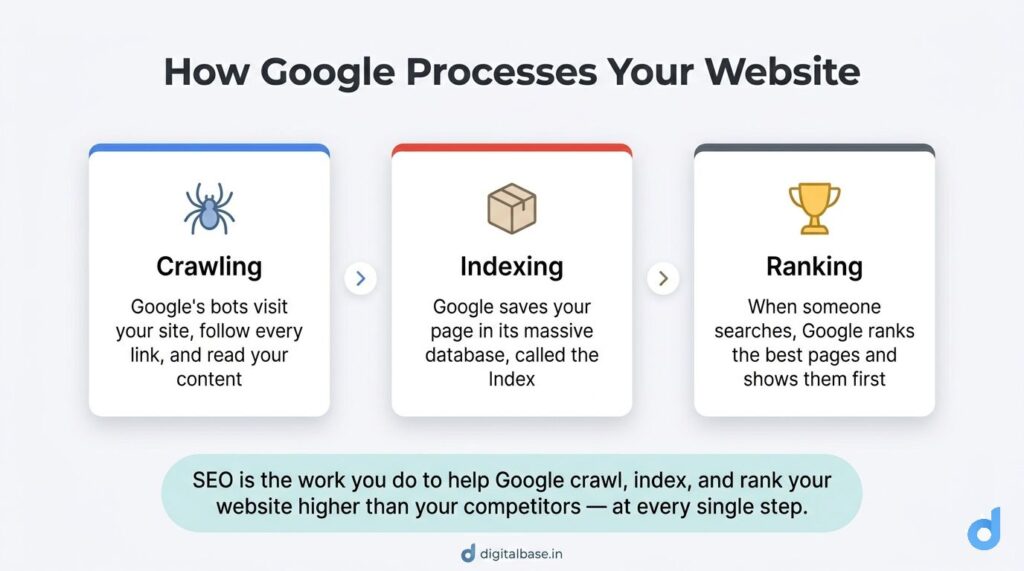
Text coGoogle uses automated programs called crawlers — also known as bots or spiders. Their job is to travel across the internet, visit websites, follow links, and read your content.
Think of Google’s crawler like a traveller exploring a new city. It follows every road (link) it finds, reads every sign (your content), and takes notes to bring back to Google headquarters.ntent
Critical: If Google can’t crawl your site properly, it won’t understand your content — and it will never rank you. Crawling is the first gate. Fail here, and nothing else matters.
After crawling, Google decides whether to store your page in its database — called the Google Index. This is Google’s giant digital library of every web page it knows about.
If your page gets indexed, it lives in the library and can appear in search results. If it doesn’t — it’s as if it doesn’t exist.
Check if your site is indexed
Open Google and search site:yourwebsite.com — if pages appear, you’re indexed. If nothing appears, that’s a problem to fix.
This is the step everyone cares about.When someone searches on Google, it scans its index and ranks pages in order — best on top — in under one second.
Google uses over 200 ranking factors to decide position #1. The main ones :
Relevance
Does your content answer what the user searched for?
Content Quality
Is your content clear, detailed, helpful, and original?
Website Speed
Does your page load fast, especially on mobile?
User Experience
Is your site easy to read, navigate, and use?
Authority (Backlinks)
Do other trusted websites link to your content?
SEO is the work you do to score higher on all of these
— so Google has every reason to put you at the top.
SEO is not just one thing. For Google to crawl, index, and rank your website properly, you need to work on three different areas — each one handles a different part of your website
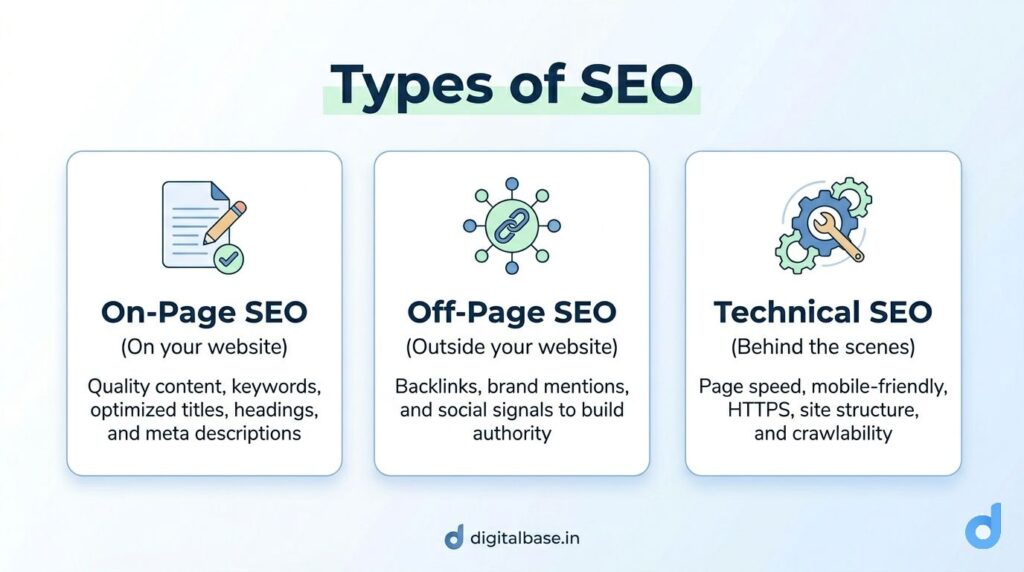
Think of it as a three-legged stool.
Remove any one of the three legs — On-Page, Off-Page, or Technical — and the whole thing becomes unstable. You need all three working together for strong, lasting rankings.
SEO stands for Search Engine Optimization — the process of optimizing a website so it ranks higher in search engine results pages (SERPs) like Google(SERPs) like Google
Crawling — Google’s bots visit and read your site.
Indexing — Google stores your page in its database.
Ranking — Google orders pages by relevance, quality, and authority when someone searches.
Paid ads (like Google Ads) give instant visibility but cost money every time someone clicks. SEO brings organic (free) traffic, but takes more time to build. Most successful digital marketers use both strategies together.
Most websites start seeing noticeable results in 3 to 6 months with consistent effort. Competitive keywords take longer; low-competition topics can rank faster. SEO is a long-term investment — but once it works, it keeps working.
Absolutely. SEO is a learnable skill. Free resources, YouTube tutorials, and beginner-friendly guides like this one can help you master SEO step by step — no prior experience needed.
Have a project in mind? Let’s create a digital solution that fits your goals and budget
We help businesses build, grow and succeed online through website development, SEO, social media management and paid advertising — with practical solutions at affordable prices.
Follow DigitalBase for digital marketing tips, SEO insights, website tips and business growth strategies.
Copyright © 2026 DigitalBase. All Rights Reserved.
Call Us